Optimizing a Talent Acquisition Funnel
Designing a pre-application pipeline that lets apprenticeship programs discover, evaluate, and warm early-career talent before the application window ever opens.
Understanding the Trades Hiring Funnel
At Runwayz, our job is to connect emerging talent with the people who hire and train them. In the skilled trades, that hiring entity is a Joint Apprenticeship Training Committee (JATC), a training trust co-governed by a local union and its contractors. The JATC owns the whole recruiting process: when applications open, the aptitude test, the interview panel, and the ranked list that decides who gets indentured.
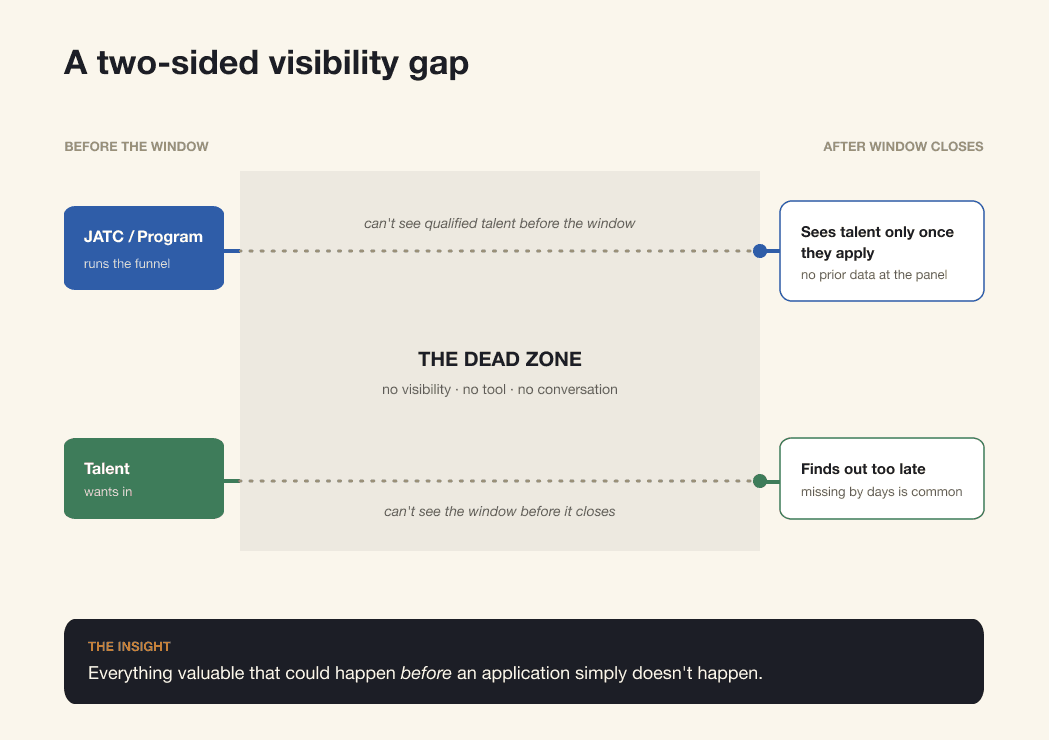
When I dug into how that process actually works, I found the same problem showing up on both sides of our market. For the JATC, the funnel only fires once. Application windows open at odd times (some annual, some semi-annual, some rolling) and a program has almost no visibility into qualified talent until an application lands inside that narrow window. Everything before that is analog: career fairs, CTE partnerships, demo days, guidance-counselor literature, and a lot of word-of-mouth that nobody measures.
For the talent, missing the window by a few days is one of the most common ways a qualified person never becomes an apprentice. They can't see when to apply, they have no sense of how a panel will read them, and they have no way to show the exact things the panel is grading: reliability, work ethic, willingness to learn. They walk into a ten-minute interview as a stranger and get judged on a transcript and a test score.
So the real problem is a visibility-and-conversion gap that hurts both sides at once. Programs can't see or evaluate talent before the window, and talent can't see or prepare for the window before it closes. Everything valuable that could happen before an application - discovery, evaluation, warming, preparation - is getting lost. I originally assumed this was a top-of-funnel volume problem; talking with our key stakeholders informed me otherwise.
.png&w=3840&q=75)
.png&w=3840&q=75)
Identifying the High-Leverage Moment
I ran a discovery-stage research plan around one question: how do trade unions actually recruit early-career talent today, and where does the funnel break down? I combined a review of published JATC application processes with live interviews anchored on Runwayz' key stakeholders. Four things came back that reshaped how I saw the unmet need.
First, recruitment is owned by the JATC, and selection is mostly soft signal. The official rubric scores education, ability, work experience, reliability, interest, attitude, judgment, and cooperation. But when I asked stakeholders what they're really listening for, the list turned into behavioral signals that are really hard to make without any prior data on the candidate. How could we position ourselves to solve this problem?
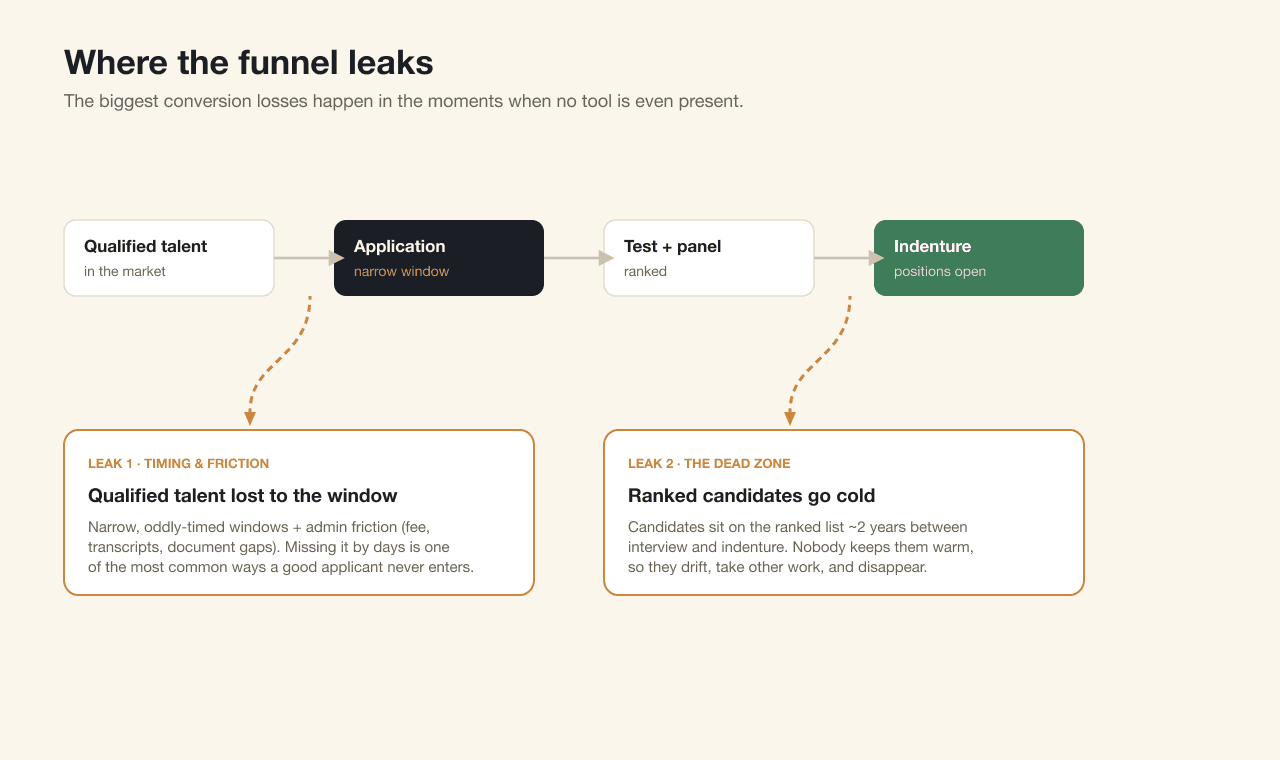
Second, the highest-leverage moment is before the application. My research identified a large dead zone where qualified talent is on the market but completely invisible to the program, as well as when ranked candidates go cold between interview and indenture. Pair that dead zone with narrow windows where applicants are routinely lost to timing and admin friction, and the pattern is obvious: the biggest conversion losses happen in the months when there is no tool at all.
Third, Work-Based Learning is the strongest evidence a candidate can bring. A 200-hour pre-apprenticeship completion is far better panel evidence than a transcript, because it's behavior accumulated over time instead of a snapshot. That told me the candidate profile should surface behavioral evidence over time, which is concrete evidence that a short interview just can't capture.
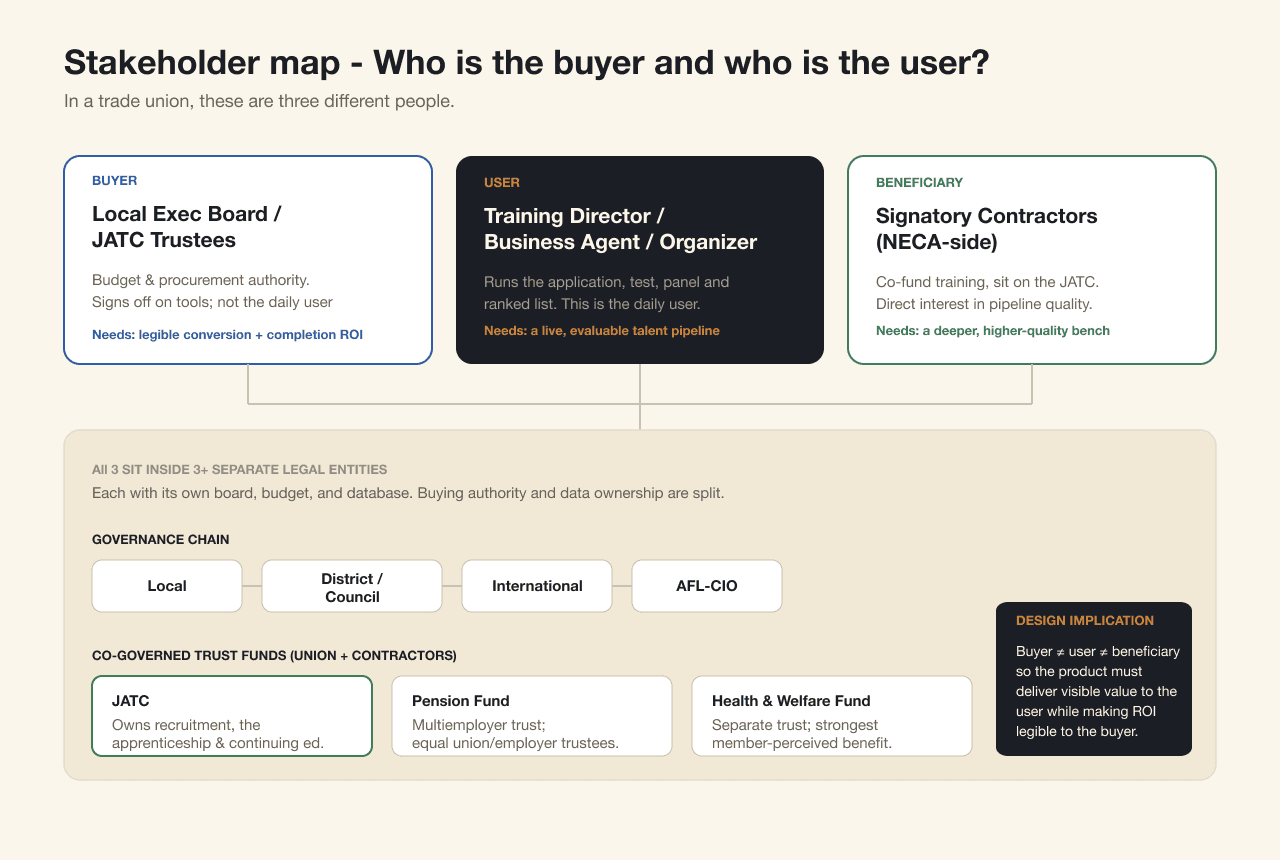
Fourth, the buyer is not the user. Density is at a record-low (10.7%), the trades face a demographic cliff, and training is funded by member dues and contractor contributions, so a bigger, better-converted top of funnel is a means of survival. But I also had to design around a buying reality: the budget sits with the local exec or the JATC trustees, the daily user is the Training Director or Business Agent, and the signatory contractors are the ones who benefit. Three different people across three or more legal entities, each with different needs.
Thus, the problem wasn't volume but the absence of any structured discovery-and-evaluation layer in the pre-application window.
.png&w=3840&q=75)
Designing for the Problem
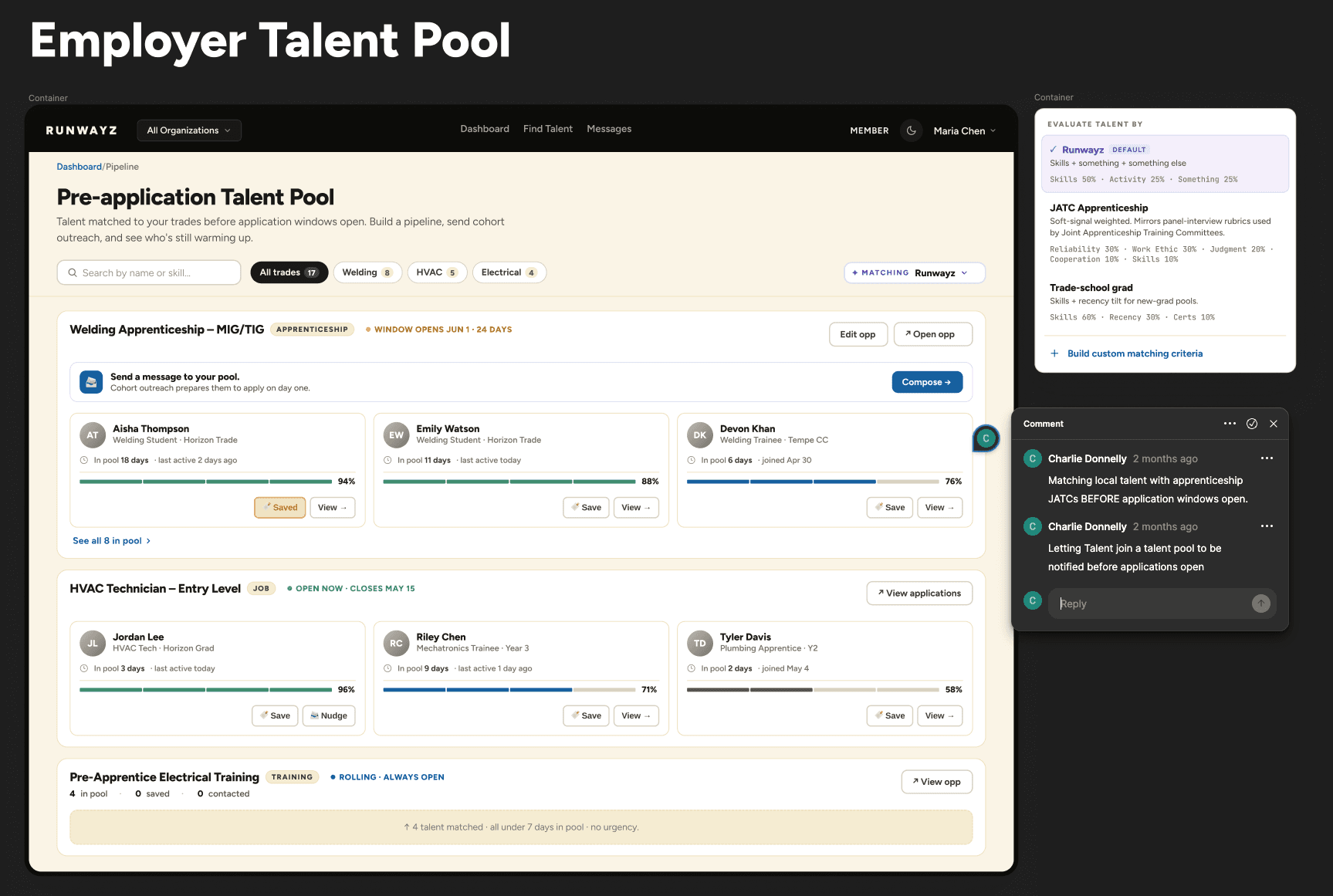
I now understood my solution space: a place where a JATC can collect and evaluate talent before the window opens, and where talent can be discovered long before they apply. Below are my three key design decisions:
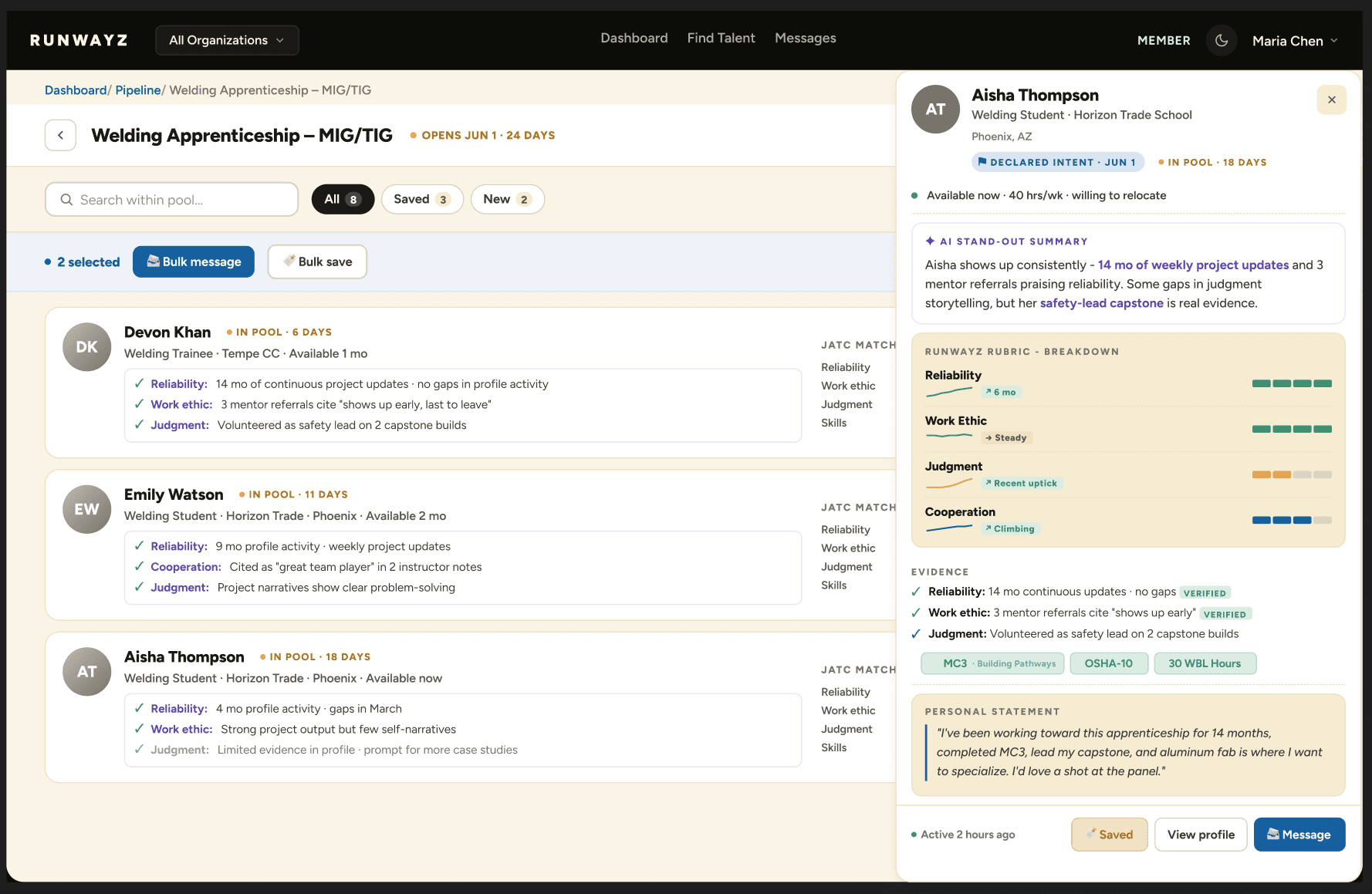
The first was to make the rubric the foundation. The panel decision is soft-signal with no prior data, so the most valuable thing Runwayz can hand a JATC is evidence against the traits they already grade. A panel that doesn't trust a number can click through and audit it, so everything Runwayz evaluates will be on display in plain English.
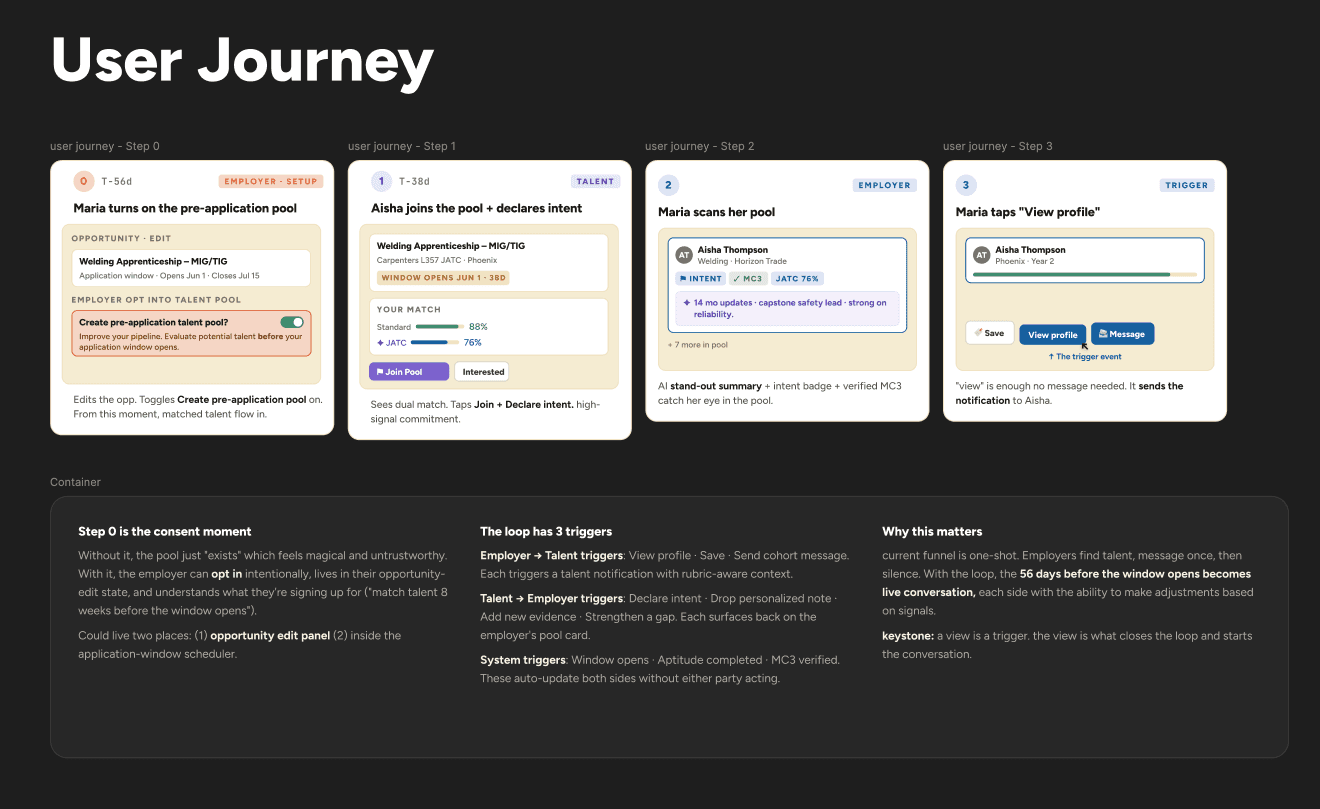
The second was to start the user journey with a consent moment. A talent pool that just exists feels untrustworthy to a program and exploitative to talent, so the pipeline starts at Step 0: the employer opts in and turns on a pre-application pool from the opportunity-edit panel. On the other side, candidates join the pool and declare intent.
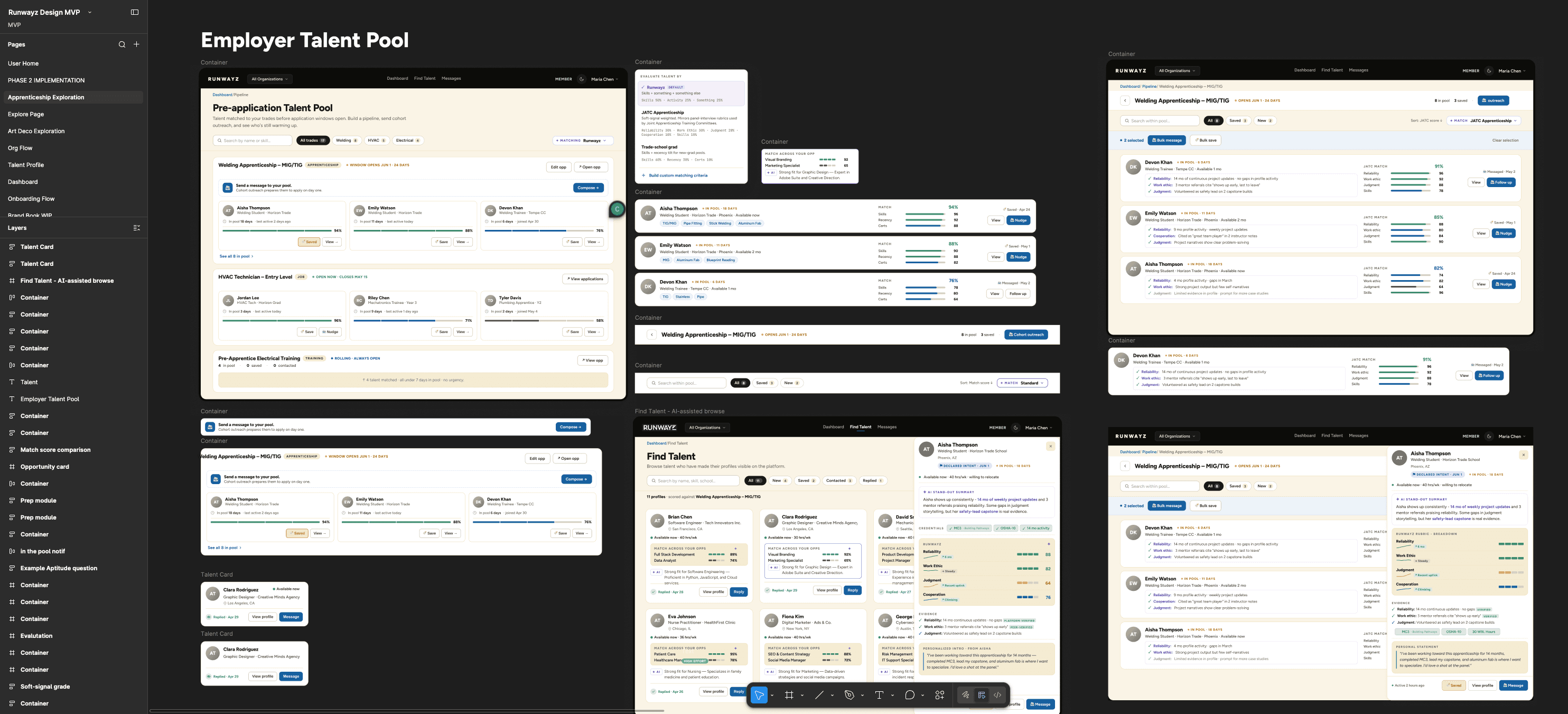
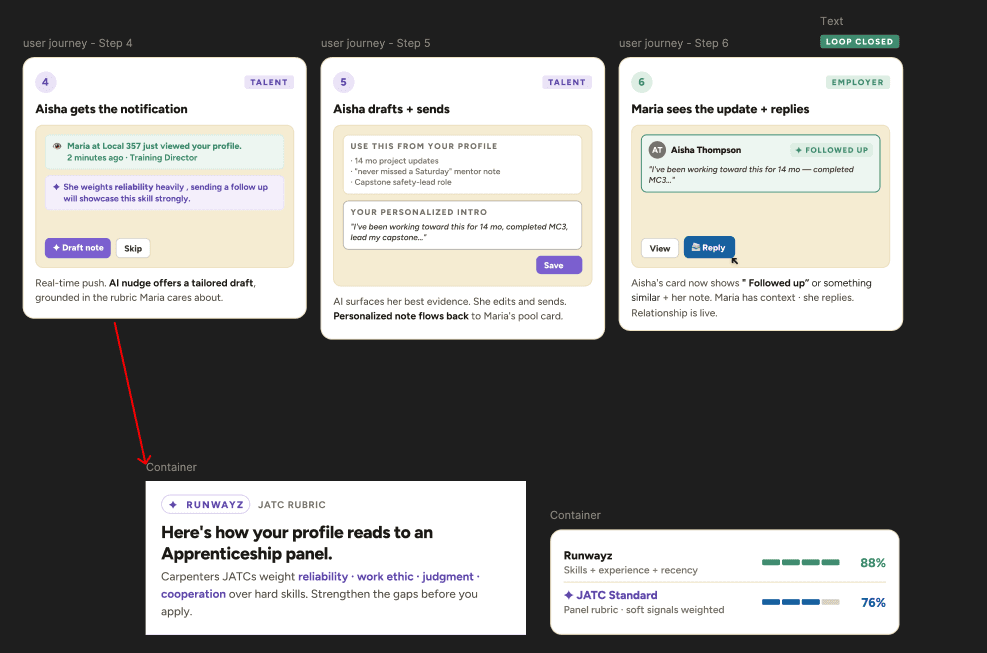
The third was to close the loop. The current funnel is one-shot, so I replaced it with a triggered loop: employer-to-talent actions, talent-to-employer actions, and system triggers that all connect back to the other side. The result is a single employer talent pool surface where a Training Director can see matched talent per opportunity, evaluate them against a configurable rubric, send cohort outreach that gets people ready to apply on day one, and see who's actually interested — all before the window opens.
Results & Impact
The next step is to pressure-test the feature through a pilot with a couple of our JATC partners. I'm aiming it squarely at the two assumptions the research broke: visibility and conversion.
On timing, qualified applicants are lost today because windows are narrow and outreach is analog. A pool of opted-in candidates who get notified the moment a window opens should convert far better than cold word-of-mouth, and I'm targeting a 30–40% lift in qualified applications per window. On evaluation, a panel today walks in with a transcript, a test score, and effectively no behavioral signal. The rubric layer takes evidence coverage from 0% to the majority of ranked candidates, which should give panels 2–3× the actionable signal before the interview even starts.
The risk on both is adoption. If Training Directors don't trust the scores enough to lean on them, none of it matters, which stresses the importance of the audit trail. I started this convinced the job was more volume at the top. The research taught me the leverage was in building the discovery-and-evaluation layer that doesn't exist in the weeks before an application opens. I'm excited to see how this feature evolves.
Challenging initial assumptions.
Deep user research synthesis.
Data-driven design decisions.
Measurable success metrics.